
Guides
Park, Trailhead & Access Road Construction
Self-performing park access road construction in Arizona. Gravel roads, geocell stabilization, monsoon drainage and Rule 310 dust control — built by the crew that quoted it.
By Jenterra · · 10 min read
Quick Answer: Park access road construction in Arizona requires subgrade preparation matched to native soil conditions, proper drainage crown and swale design for monsoon events, and stabilization methods that handle seasonal traffic loads without rutting or washout. Jenterra's self-performing crews cut, grade, stabilize and surface access roads from trailhead to interior loop — with the person who quoted your project walking the finished grade.
Recreational parks, trailheads and campgrounds depend on access roads that stay passable through monsoon season, withstand heavy visitor traffic on summer weekends, and meet Maricopa County Rule 310 dust control requirements. Whether you're a county parks department building a new trailhead, a developer opening a private campground, or a land trust improving access to conservation areas, the road itself determines how the property functions.
We build gravel access roads across Arizona — from high-desert forest service corridors near Flagstaff to low-desert recreation sites in Maricopa County. Our crews handle excavation through caliche, laser grading for proper drainage, geocell stabilization for soft subgrades, and non-chloride dust suppression that protects Arizona land and water.
What Park Access Road Construction Involves
Access roads for parks and trailheads aren't scaled-down highways — they're purpose-built circulation systems designed for mixed traffic (pedestrians, vehicles, maintenance equipment, sometimes horses) and seasonal load variations. The construction sequence addresses each layer from native subgrade to finished surface:
Subgrade preparation starts with clearing and rough grading to establish alignment and elevation. In much of Arizona, this means cutting through caliche — the calcium-carbite hardpan that requires specialized hard-dig techniques. Our excavation crews work caliche regularly and know when it serves as structural support versus when it creates drainage problems that need correction.
Drainage grading shapes the road crown, side swales and cross-drainage structures. Arizona monsoons deliver intense rainfall in short bursts; a park road without proper crown (typically 2–4% cross-slope depending on width and surface material) channels water down the driving surface instead of shedding it to swales. We use laser grading equipment to hit specified grades within tight tolerances.
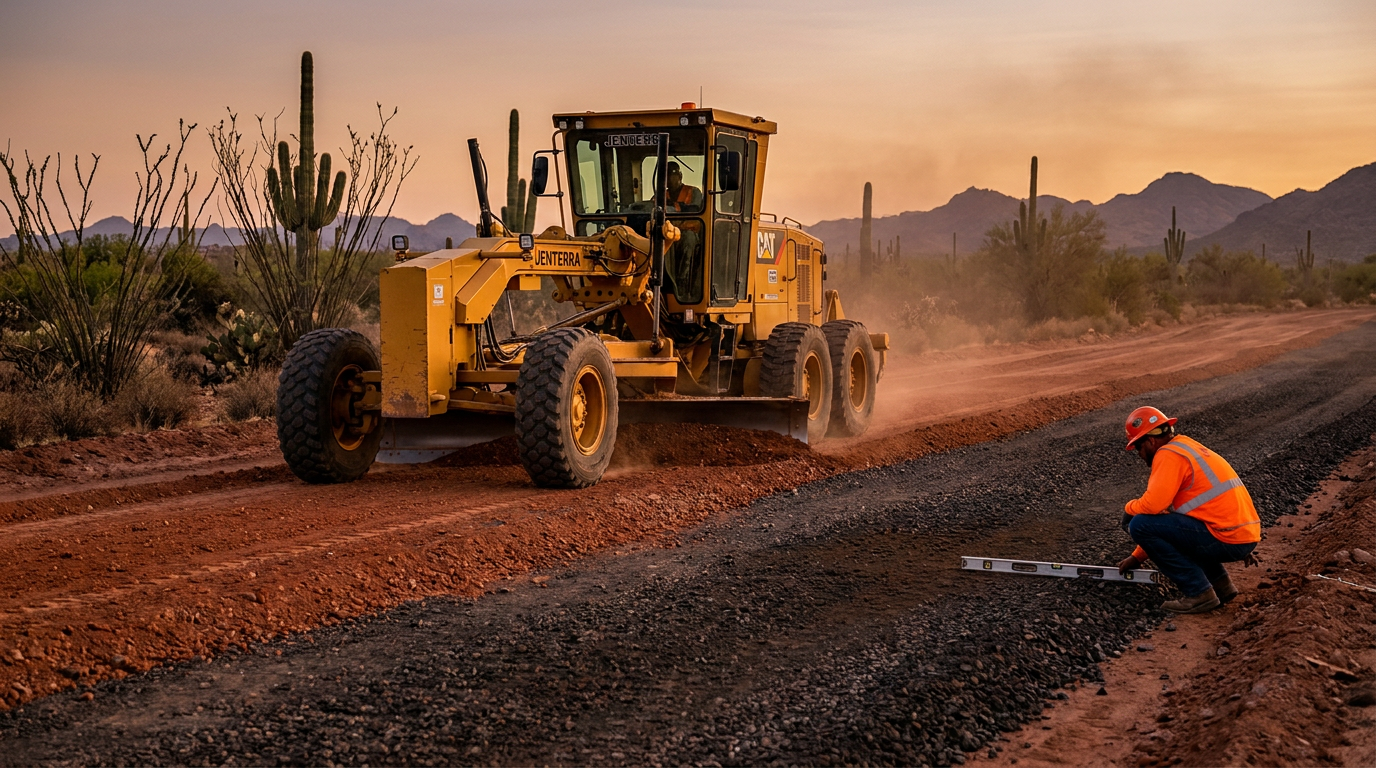
Base and surface courses vary by traffic load, soil conditions and maintenance expectations. Aggregate base depths typically range from 4–8 inches depending on subgrade bearing capacity and anticipated loads; surface courses add another 2–4 inches of wearing surface material. Where subgrade conditions are marginal — expansive clays, loose decomposed granite, or areas with seasonal saturation — geocell confinement systems reduce base thickness requirements while improving long-term stability.
Arizona Soil and Drainage Conditions That Shape Road Design
Park access roads in Arizona face conditions that differ significantly from roads in wetter climates. Understanding these conditions determines whether a road holds up or washes out:
| Condition | Low-Desert Sites (Phoenix Basin) | High-Desert Sites (Flagstaff/Rim Country) |
|---|---|---|
| Dominant Subgrade | Caliche, decomposed granite, alluvial soils | Volcanic cinders, clay pockets, forest duff |
| Primary Drainage Challenge | Monsoon sheet flow, flash runoff | Snowmelt saturation, spring mud season |
| Typical Freeze-Thaw Cycles | Minimal | Frequent October–April |
| Dust Control Priority | Year-round (Rule 310 compliance) | Seasonal (dry periods) |
| Erosion Risk Period | July–September monsoons | Spring snowmelt + summer monsoons |
These differences affect base thickness, aggregate selection, drainage structure spacing and stabilization approach. A road specification that works near Payson may fail near Buckeye — not because of traffic, but because of how water moves through the soil profile.
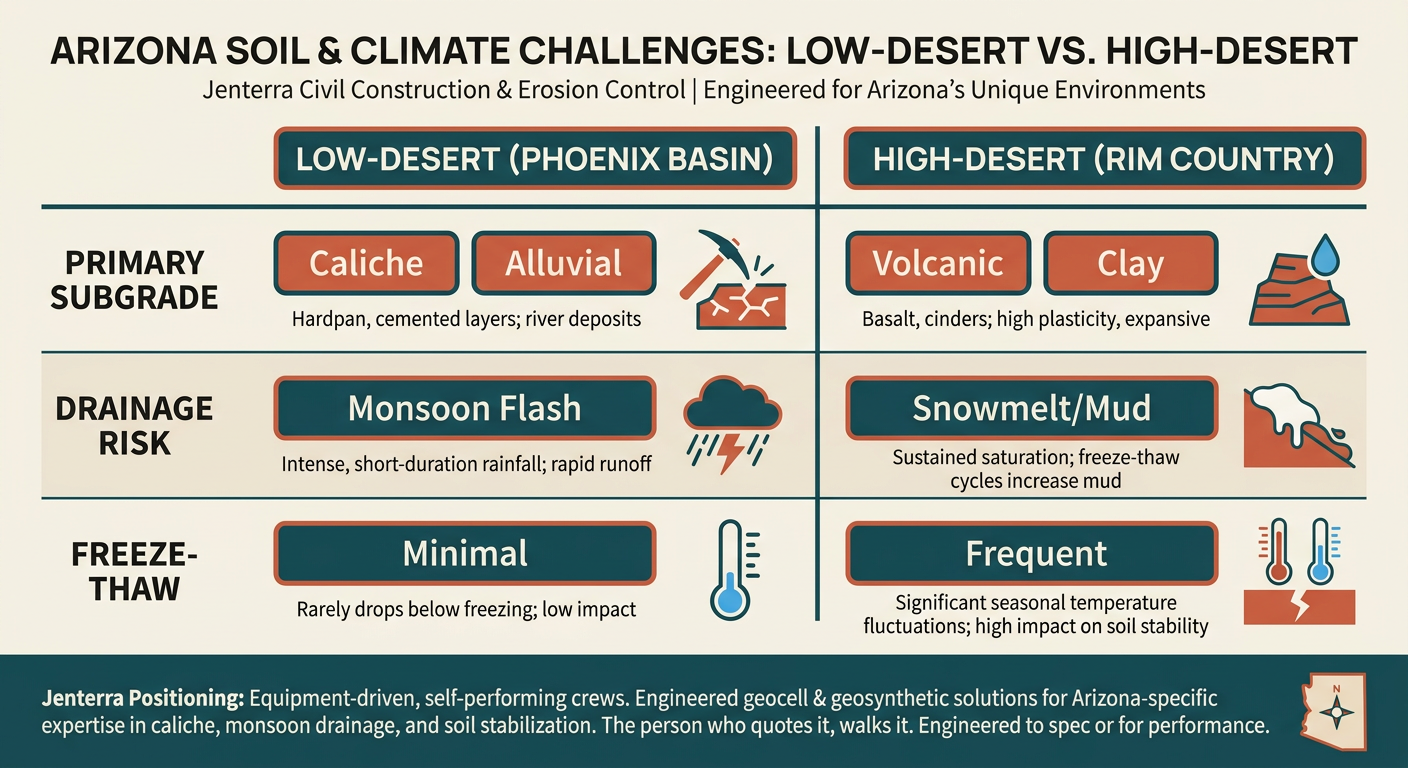
We've graded and stabilized roads across both zones. Our Flagstaff-area gravel road work accounts for freeze-thaw and snowmelt; our low-desert projects prioritize monsoon drainage and year-round dust suppression.
Geocell Stabilization for Problem Subgrades
Not every park site has cooperative soil. Trailheads at canyon edges may sit on loose fill. Campground loops may cross seasonal wet areas. Access roads to remote sites may traverse decomposed granite that ruts under heavy loads.
Geocell ground stabilization addresses these conditions by confining aggregate within a three-dimensional cellular structure. The Federal Highway Administration research on cellular confinement systems documents how geocells distribute loads laterally, reducing point stress on weak subgrades.
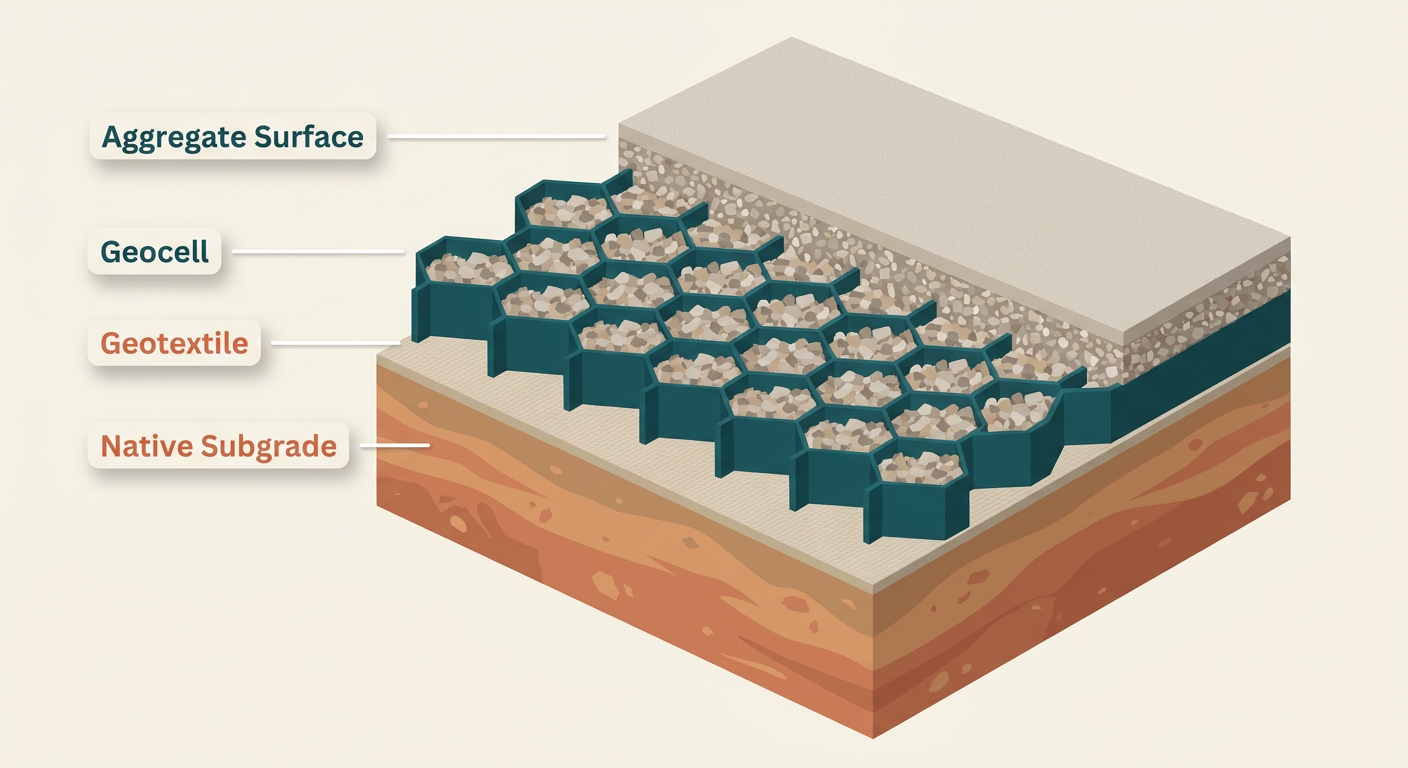
For park access roads, geocell offers practical advantages:
- Reduced aggregate import — geocell-reinforced sections often require 30–50% less base depth than unreinforced sections over the same subgrade
- Improved edge stability — cell walls prevent lateral migration of aggregate at road edges
- Seasonal resilience — confined aggregate resists frost heave and wet-season softening better than loose-laid material
We install geocell as part of the road build — same crew, same accountability. The materials come from our geocell and geosynthetic inventory; the installation follows manufacturer specifications matched to your site conditions.
Building a park, trailhead or campground access road? We walk the site, evaluate soil and drainage, and provide a scope-specific quote. Request an Estimate to start the conversation.
Drainage Structures and Erosion Control Integration
A gravel access road is also a drainage system. Water that doesn't shed properly erodes the surface, undercuts edges and deposits sediment where you don't want it. Arizona park sites often have additional requirements under SWPPP regulations for construction-phase erosion control and permanent best management practices.
Our erosion and sediment control services integrate with road construction:
Cross-drainage structures — culverts, low-water crossings, rolling dips — manage concentrated flow across the road alignment. Sizing and spacing depend on watershed area, slope and expected flow volumes. The USDA Natural Resources Conservation Service provides guidance on drainage structure design for unpaved roads that we reference when engineering isn't provided.
Swale and ditch stabilization prevents scour where concentrated flow exits the road system. Options include rock check dams, erosion control blankets for vegetated channels, and geocell-lined ditches for high-velocity flow.
Sediment control during construction uses wattles, silt fence and inlet protection to keep disturbed material on site. We install, inspect and maintain BMPs through project completion — not a separate subcontractor handoff.
Dust Control for Park and Recreation Sites
Unpaved roads generate dust. In Maricopa County, that dust falls under Rule 310 requirements with specific control measures and documentation obligations. Even outside the regulated area, dust affects visitor experience, adjacent habitats and maintenance costs.
We apply plant-based, non-chloride dust suppressants that meet Rule 310 requirements without the environmental concerns of petroleum-based or chloride products. These suppressants bind fine particles while allowing water infiltration — important for roads designed with permeable surfaces.
Dust control application rates depend on traffic volume, soil type and climate. A high-use trailhead parking entrance may need more frequent treatment than a low-traffic interior maintenance road. We discuss expected use patterns during scoping so the dust control plan matches actual conditions.
Trailhead and Parking Area Integration
Access roads often terminate at or connect trailhead parking areas, interpretive sites or campground registration zones. These transition areas need consistent grading, drainage and surface treatment:
Parking surface options range from compacted aggregate to permeable gravel systems that manage stormwater on site. For sites with infiltration requirements or limited drainage outlet options, permeable parking reduces downstream infrastructure needs.
ADA-accessible routes from parking to trailheads or facilities require specific grades, surface firmness and cross-slope limits. We grade accessible routes to meet federal accessibility guidelines when specified.
Campground internal roads connect entry roads to individual sites, dump stations and amenity areas. Our RV park and campground site development experience includes the full internal circulation system — not just the access road in isolation.
Working With Public Agencies and Prime Contractors
Park access road projects often involve multiple stakeholders — county parks departments, federal land managers, conservation districts, or prime contractors managing larger recreation facility developments. We work within these structures:
For public agencies: Jenterra is a woman-owned Arizona company. We provide capability documentation, capability statements and insurance certificates as required for agency procurement. We're familiar with public project documentation requirements and inspection protocols.
For prime contractors: We function as a self-performing earthwork subcontractor with clear scope boundaries. Our GC partnership page outlines how we integrate with larger project teams. The person who walks your pre-bid site visit is the person who runs the work.
For private developers and land trusts: We work directly with owners on private campground, retreat center and conservation access projects. Same direct accountability — you know who's responsible from quote through final grade.
Project Approach: From Site Walk to Finished Road
Every park access road project follows a consistent sequence adapted to site conditions:
Site evaluation — We walk the alignment, observe soil conditions, note drainage patterns and discuss intended use. For sites with existing engineering, we review plans and clarify scope. For sites without engineering, we identify what's needed to develop a buildable specification.
Scope development — Based on site conditions and your requirements, we define excavation quantities, aggregate specifications, stabilization approach, drainage structures and dust control measures. We provide a detailed written scope with unit pricing where appropriate.
Mobilization and construction — Our crews bring the equipment matched to the work — motor graders, excavators, compaction equipment, laser systems. We don't subcontract the core earthwork; the crew that shows up is our crew.
Quality verification — We grade to specified tolerances and verify compaction. If third-party testing is required, we coordinate with the testing agency and address any deficiencies promptly.
Closeout — Final grading, dust control application, BMP installation and as-built documentation as required. For projects with maintenance provisions, we establish the schedule and reporting format.
What We Don't Do
Clarity about scope boundaries prevents confusion:
- We don't pave with asphalt or concrete — our roads are aggregate-surfaced
- We don't install utilities, culvert pipe larger than what's required for cross-drainage, or storm drain systems
- We don't construct bridges or large-span structures
- We don't perform landscaping or revegetation beyond erosion control seeding as part of BMP installation
For projects requiring these elements, we coordinate with the responsible contractors or recommend qualified firms.
Ready to discuss your park access road project? Contact us for a site walk and scope-specific estimate. The person who quotes it is the person who walks it. Get an Estimate →